How to use ParseEyetrackerFile
This notebook illustrates how to read in the output from the EyeLink-software, as implemented with exptools.
[10]:
%matplotlib inline
[2]:
# imports
from linescanning import (
    dataset,
    plotting,
    fitting
    )

import os
opj = os.path.join
opd = os.path.dirname
221207-14:58:37,988 nipype.utils WARNING:
         A newer version (1.8.4) of nipy/nipype is available. You are using 1.8.2
Whenever you run an experiment with exptools, you’ll get an edf-file. This file can be read in with hedfpy, which is wrapped into the ParseEyetrackerFile-class within the linescanning-toolbox. I have provided an example dataset eye.edf. This is from a recent 3D-EPI
acquisition with a TR of 1.1s, and 270 volumes (this is necessary to extract the correct time period of the eyetracking)
[3]:
# define an edf file
edf_file = opj(opd(opd(dataset.__file__)), 'examples', 'eye.edf')
The hard part is actually getting the eyetracking data, processing is not that difficult really. We can just plop everything in the class and check it’s read-outs, but first let’s try to understand what happens under the hood.
From hedfpy:
“For full parsing of the edf file data, hedfpy assumes a specific trial-based experimental format that is communicated to the eye tracker. Specifically, it looks for explicitly formatted messages by means of regular expressions. These messages detail the start and end of trial phases, trials, button press events, sound events and the stimulus parameters for a given trial which are all stored in tabular format in the HDF5 file. The parsing of these messages can be turned off for basic
functionality.”. This hdf5-file is stored in the directory in which edf_file lives. It will also store other outputs - such as basic quality assessments - in that folder.
The way the line-scanning toolbox is reading in data is as follows:
Either use specific classes as stand-alone (e.g., ParseEyetrackerFile, or ParseExpToolsFile)
Combine eyetracker and exptools file (in case of psychophysical experiments) with ParseExpToolsFile
Combine eyetracker, exptools, and functional files with ParseFuncFile or the dataset-class
In any case, it’s best to use use_bids=True, as this will read subject/session/run-specific information from the file itself. If you’ve done the same for your functional files, every dataframe that comes out of this lines up index-wise, which is great (and which is why it’s default!). Because our edf-file is called eye.edf, I’ll turn off use_bids.
Let’s see how that looks:
Stand-alone usage
[4]:
nr_vols = 270
TR = 1.1

eye_ = dataset.ParseEyetrackerFile(
    edf_file,
    use_bids=False,
    verbose=True,
    nr_vols=270,
    TR=TR
)
I was able to import hedfpy

EYETRACKER
22-12-07_14-58-39 - INFO - EDFOperator - started with eye.edf
22-12-07_14-58-39 - INFO - EDF2ASCOperator - <hedfpy.CommandLineOperator.EDF2ASCOperator object at 0x7f1e2c01d760> initialized with file eye.edf
22-12-07_14-58-39 - DEBUG - EDF2ASCOperator - <hedfpy.CommandLineOperator.EDF2ASCOperator object at 0x7f1e2c01d760>executing command
edf2asc -t -ftime -y -z -v -s -miss 0.0001 -vel "/data1/projects/MicroFunc/Jurjen/programs/packages/linescanning/examples/eye.edf"; mv "/data1/projects/MicroFunc/Jurjen/programs/packages/linescanning/examples/eye.asc" "/data1/projects/MicroFunc/Jurjen/programs/packages/linescanning/examples/eye.gaz"; edf2asc -t -ftime -y -z -v -e "/data1/projects/MicroFunc/Jurjen/programs/packages/linescanning/examples/eye.edf"; mv "/data1/projects/MicroFunc/Jurjen/programs/packages/linescanning/examples/eye.asc" "/data1/projects/MicroFunc/Jurjen/programs/packages/linescanning/examples/eye.msg"
22-12-07_14-58-42 - INFO - EDFOperator - reading trials from eye.msg
22-12-07_14-58-42 - INFO - EDFOperator - no parameter information in edf file
22-12-07_14-58-42 - INFO - EDFOperator - reading key_events from eye.msg
22-12-07_14-58-43 - INFO - EDFOperator - reading key_events from eye.msg
22-12-07_14-58-43 - INFO - EDFOperator - reading key_events from eye.msg
22-12-07_14-58-43 - INFO - EDFOperator - reading eyelink events from eye.msg
22-12-07_14-58-43 - INFO - EDFOperator - reading sounds from eye.msg
22-12-07_14-58-43 - INFO - EDFOperator - cleaning gaze information from /data1/projects/MicroFunc/Jurjen/programs/packages/linescanning/examples/eye.gaz
22-12-07_14-58-47 - INFO - EDFOperator - identifying recording blocks from /data1/projects/MicroFunc/Jurjen/programs/packages/linescanning/examples/eye.gaz
22-12-07_14-58-47 - INFO - EDFOperator - 1 raw blocks discovered
22-12-07_14-58-47 - INFO - EDFOperator - 373457.000000 raw block duration, threshold 30000.000000
22-12-07_14-58-47 - INFO - EDFOperator - 1 correct duration blocks discovered
22-12-07_14-58-49 - INFO - EDFOperator - found data from block 0 of shape (373457, 6)
22-12-07_14-58-50 - INFO - HDFEyeOperator - Adding message data from eye.edf to group  run_1 to /data1/projects/MicroFunc/Jurjen/programs/packages/linescanning/examples/eye.h5
22-12-07_14-58-50 - INFO - HDFEyeOperator - Adding gaze data from eye.edf to group  run_1 to /data1/projects/MicroFunc/Jurjen/programs/packages/linescanning/examples/eye.h5
22-12-07_14-58-50 - INFO - EyeSignalOperator - Interpolating blinks using interpolate_blinks
22-12-07_14-58-50 - INFO - EyeSignalOperator - Band-pass filtering of pupil signals, hp = 0.010, lp = 6.000
22-12-07_14-58-50 - INFO - EyeSignalOperator - Regressing blinks, saccades and gaze position of pupil signals
[(373457,), (373457,)]
22-12-07_14-58-50 - INFO - EyeSignalOperator - Nuisance GLM Results, pearsons R (p) is 0.225 (0.0000)
22-12-07_14-58-50 - INFO - EyeSignalOperator - Nuisance GLM Results, blink beta 305.27923542121846
22-12-07_14-58-50 - INFO - EyeSignalOperator - Nuisance GLM Results, saccade beta -44.34956672331177
22-12-07_14-58-53 - WARNING - EyeSignalOperator - time_frequency_decomposition_pupil:
                                    requested minimal_frequency 0.00250 smaller than
                                    data allows (0.00268).
22-12-07_14-58-53 - INFO - EyeSignalOperator - Time_frequency_decomposition_pupil, with filterbank [0.1        0.06305834 0.03976354 0.02507422 0.01581139 0.0099704
 0.00628717 0.00396458 0.0025    ]
22-12-07_14-58-53 - INFO - HDFEyeOperator - Performed T-F analysis of type lp_butterworth
22-12-07_14-58-53 - INFO - HDFEyeOperator - Saved T-F analysis 0.10000
22-12-07_14-58-53 - INFO - HDFEyeOperator - Saved T-F analysis 0.06306
22-12-07_14-58-53 - INFO - HDFEyeOperator - Saved T-F analysis 0.03976
22-12-07_14-58-53 - INFO - HDFEyeOperator - Saved T-F analysis 0.02507
22-12-07_14-58-53 - INFO - HDFEyeOperator - Saved T-F analysis 0.01581
22-12-07_14-58-53 - INFO - HDFEyeOperator - Saved T-F analysis 0.00997
22-12-07_14-58-53 - INFO - HDFEyeOperator - Saved T-F analysis 0.00629
22-12-07_14-58-53 - INFO - HDFEyeOperator - Saved T-F analysis 0.00396
22-12-07_14-58-53 - INFO - HDFEyeOperator - Saved T-F analysis 0.00250
Preprocessing /data1/projects/MicroFunc/Jurjen/programs/packages/linescanning/examples/eye.edf
 Alias:        run_1
 Sample rate:  1000
 Start time:   3566804.0
 Stop time:    3863804.0
 Duration:     297.0s [297000 samples]
 Fetching:     ['pupil', 'pupil_int', 'gaze_x_int', 'gaze_y_int', 'gaze_x', 'gaze_y']
 Start time exp =  107.72
 Found 26 blinks [0.09 blinks per second]
 Found 579 saccades
Done
Ideally, this does not return an error. If so, we can inspect some of the parameters it extracted from the file (see the list after Fetching above)
[5]:
# we get a dataframe for blink onsets
eye_.df_blinks.head()
[5]:
| onset | |||
|---|---|---|---|
| subject | run | event_type | |
| 1 | 1 | blink | 3.298 |
| blink | 11.899 | ||
| blink | 17.987 | ||
| blink | 31.194 | ||
| blink | 43.787 |
[6]:
# and gaze/pupil size both in eyetracking time (@sample rate)
eye_.df_space_eye.head()
[6]:
| pupil | pupil_int | gaze_x_int | gaze_y_int | gaze_x | gaze_y | |||
|---|---|---|---|---|---|---|---|---|
| subject | run | t | ||||||
| 1 | 1 | 0.000 | 3634.0 | 3634.0 | 864.299988 | 542.000000 | 864.299988 | 542.000000 |
| 0.001 | 3627.0 | 3627.0 | 871.200012 | 511.899994 | 871.200012 | 511.899994 | ||
| 0.002 | 3679.0 | 3679.0 | 866.500000 | 519.900024 | 866.500000 | 519.900024 | ||
| 0.003 | 3630.0 | 3630.0 | 865.400024 | 538.099976 | 865.400024 | 538.099976 | ||
| 0.004 | 3686.0 | 3686.0 | 856.900024 | 517.700012 | 856.900024 | 517.700012 |
[7]:
# or resampled to the TR (useful for deconvolution of eyeblinks) > also has high-pass/percent signal changed versions. This takes too long for the data @sample_rate
eye_.df_space_func.head()
[7]:
| pupil | pupil_hp | pupil_psc | pupil_hp_psc | pupil_int | pupil_int_hp | pupil_int_psc | pupil_int_hp_psc | gaze_x_int | gaze_x_int_hp | ... | gaze_y_int_psc | gaze_y_int_hp_psc | gaze_x | gaze_x_hp | gaze_x_psc | gaze_x_hp_psc | gaze_y | gaze_y_hp | gaze_y_psc | gaze_y_hp_psc | |||
|---|---|---|---|---|---|---|---|---|---|---|---|---|---|---|---|---|---|---|---|---|---|---|---|
| subject | run | t | |||||||||||||||||||||
| 1 | 1 | 0.0 | 3634.0 | 3306.871094 | 29.478714 | 17.873978 | 3634.0 | 3301.236572 | 29.483154 | 17.548630 | 864.299988 | 861.426758 | ... | -1.320969 | 2.517723 | 864.299988 | 861.372864 | -7.246170 | -7.759895 | 542.000000 | 559.765381 | -1.320480 | 2.184196 |
| 1.1 | 2884.0 | 2557.087891 | 2.614754 | -8.982216 | 2884.0 | 2551.462402 | 2.615150 | -9.311279 | 923.000000 | 920.140625 | ... | -2.742149 | 1.095352 | 923.000000 | 920.086853 | -0.949356 | -1.461578 | 534.200012 | 551.961243 | -2.741142 | 0.762779 | ||
| 2.2 | 3193.0 | 2866.520752 | 13.682709 | 2.101234 | 3193.0 | 2860.913330 | 13.684769 | 1.774490 | 932.799988 | 929.968384 | ... | -2.323082 | 1.512039 | 932.799988 | 929.914856 | 0.101898 | -0.407318 | 536.500000 | 554.252808 | -2.322235 | 1.180161 | ||
| 3.3 | 3087.0 | 2761.168213 | 9.885933 | -1.672340 | 3087.0 | 2755.588135 | 9.887421 | -1.998680 | 915.599976 | 912.809998 | ... | 0.555717 | 4.387268 | 915.599976 | 912.756775 | -1.743164 | -2.247887 | 552.299988 | 570.040222 | 0.555519 | 4.055618 | ||
| 4.4 | 2697.0 | 2372.028076 | -4.083328 | -15.610802 | 2697.0 | 2366.484131 | -4.083939 | -15.937943 | 947.599976 | 944.865417 | ... | -5.001472 | -1.174690 | 947.599976 | 944.812622 | 1.689514 | 1.190781 | 521.799988 | 539.523315 | -4.999634 | -1.502617 |
5 rows × 24 columns
[8]:
# and saccades
eye_.df_saccades.head()
[8]:
| expanded_start_time | expanded_end_time | expanded_duration | expanded_start_point | expanded_end_point | expanded_vector | expanded_amplitude | peak_velocity | raw_start_time | raw_end_time | raw_duration | raw_start_point | raw_end_point | raw_vector | raw_amplitude | start_timestamp | end_timestamp | onset | |||
|---|---|---|---|---|---|---|---|---|---|---|---|---|---|---|---|---|---|---|---|---|
| subject | run | event_type | ||||||||||||||||||
| 1 | 1 | saccade | 272 | 292 | 20 | [866.0, 540.1] | [904.1, 492.6] | [38.099976, -47.49997] | 0.728021 | 62.434765 | 274 | 289 | 15 | [909.8, 526.3] | [864.8, 542.4] | [45.0, -16.100037] | 0.673154 | 3567076.0 | 3567096.0 | 0.272 |
| saccade | 405 | 426 | 21 | [889.8, 519.4] | [914.7, 530.3] | [24.900024, 10.899963] | 0.442447 | 37.022831 | 411 | 423 | 12 | [922.6, 524.0] | [893.9, 527.1] | [28.699951, -3.0999756] | 0.349249 | 3567209.0 | 3567230.0 | 0.405 | ||
| saccade | 1483 | 1505 | 22 | [919.1, 574.0] | [937.5, 546.8] | [18.400024, -27.200012] | 0.639112 | 53.668053 | 1489 | 1501 | 12 | [935.3, 514.5] | [913.3, 575.0] | [22.0, -60.5] | 0.500670 | 3568287.0 | 3568309.0 | 1.483 | ||
| saccade | 1852 | 1866 | 14 | [924.8, 538.7] | [939.2, 534.7] | [14.400024, -4.0] | 0.351644 | 32.373600 | 1854 | 1863 | 9 | [939.4, 516.7] | [927.9, 550.9] | [11.5, -34.200012] | 0.259657 | 3568656.0 | 3568670.0 | 1.852 | ||
| saccade | 3685 | 3707 | 22 | [931.3, 548.1] | [950.9, 519.6] | [19.600037, -28.5] | 0.604658 | 56.158707 | 3691 | 3702 | 11 | [942.1, 521.8] | [932.5, 530.0] | [9.599976, -8.200012] | 0.462714 | 3570489.0 | 3570511.0 | 3.685 |
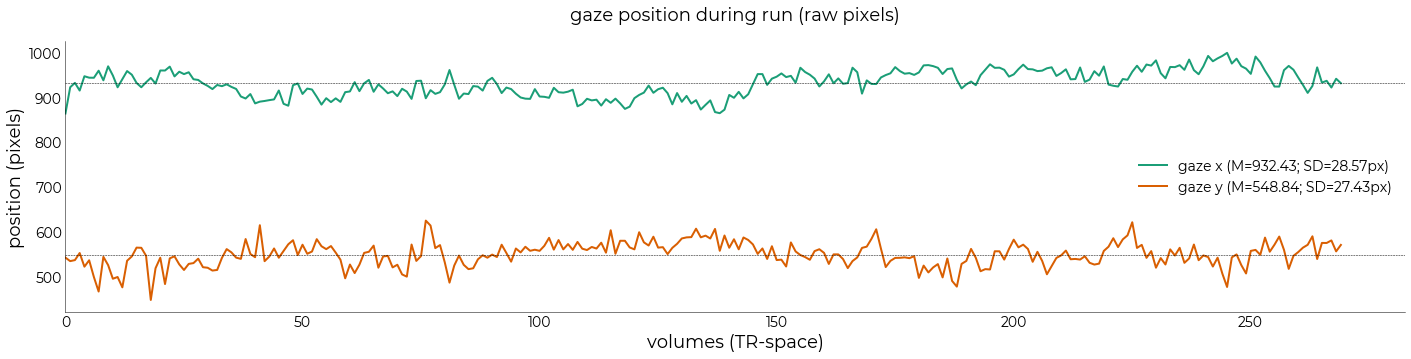
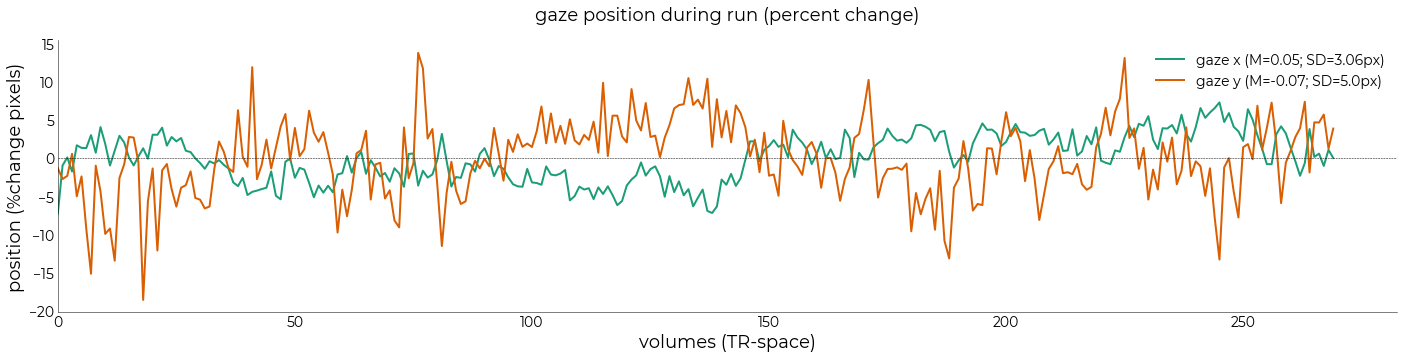
Let’s plot some stuff, like gaze. Ideally, we’d like this to be as stable as possible, meaning the subject was fixating properly.
[44]:
# gaze x/y
df_gaze = eye_.df_space_func.copy()
input_l = [df_gaze[f"gaze_{i}_int"].values for i in ["x","y"]]
avg = [float(input_l[i].mean()) for i in range(len(input_l))]
std = [float(input_l[i].std()) for i in range(len(input_l))]
plotting.LazyPlot(
    input_l,
    line_width=2,
    figsize=(24,5),
    color=["#1B9E77","#D95F02"],
    labels=[f"gaze {i} (M={round(avg[ix],2)}; SD={round(std[ix],2)}px)" for ix,i in enumerate(["x","y"])],
    x_label="volumes (TR-space)",
    y_label="position (pixels)",
    add_hline={"pos": avg},
    title="gaze position during run (raw pixels)"
)
[44]:
<linescanning.plotting.LazyPlot at 0x7f1e1858a3d0>
[43]:
# gaze x/y percent signal changed
input_l = [df_gaze[f"gaze_{i}_int_psc"].values for i in ["x","y"]]
avg = [float(input_l[i].mean()) for i in range(len(input_l))]
std = [float(input_l[i].std()) for i in range(len(input_l))]
plotting.LazyPlot(
    input_l,
    line_width=2,
    figsize=(24,5),
    color=["#1B9E77","#D95F02"],
    labels=[f"gaze {i} (M={round(avg[ix],2)}; SD={round(std[ix],2)}px)" for ix,i in enumerate(["x","y"])],
    x_label="volumes (TR-space)",
    y_label="position (%change pixels)",
    add_hline=0,
    title="gaze position during run (percent change)"
)
[43]:
<linescanning.plotting.LazyPlot at 0x7f1e11ab8e80>
[18]:
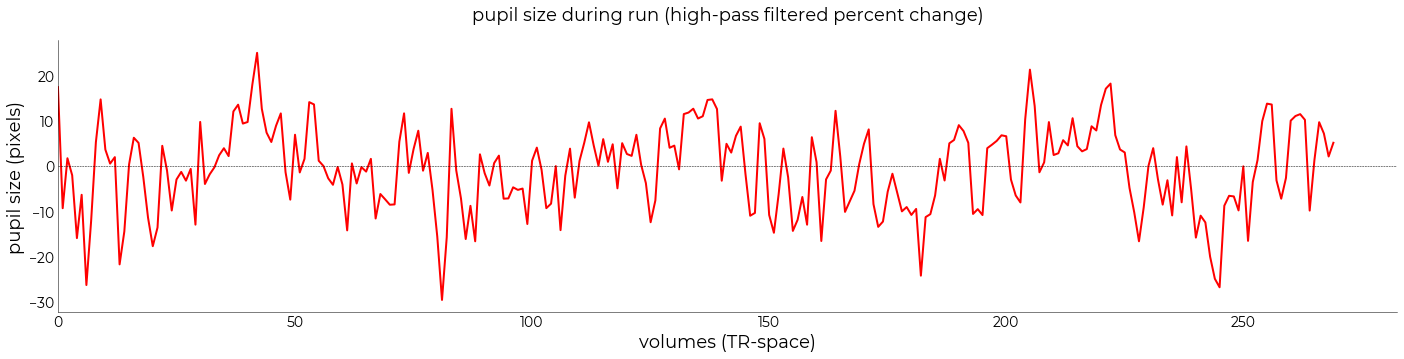
# pupil size
data = df_gaze["pupil_int_hp"].values
avg = data.mean()

# raw-ish values
plotting.LazyPlot(
    data,
    line_width=2,
    figsize=(24,5),
    color="r",
    x_label="volumes (TR-space)",
    y_label="pupil size (pixels)",
    title="pupil size during run (high-pass filtered)",
    add_hline={"pos": avg}
)

# percent change
data = df_gaze["pupil_int_hp_psc"].values
plotting.LazyPlot(
    data,
    line_width=2,
    figsize=(24,5),
    color="r",
    x_label="volumes (TR-space)",
    y_label="pupil size (pixels)",
    title="pupil size during run (high-pass filtered percent change)",
    add_hline=0
)
[18]:
<linescanning.plotting.LazyPlot at 0x7f1e184c8eb0>

We can also try to deconvolve the pupil response using the eye_.df_blinks-dataframe as onsets, and the pupil size as input data
[42]:
# deconvolve pupil response
interval = [0,7]
nd_pupil = fitting.NideconvFitter(
    df_gaze["pupil_int_hp_psc"],
    eye_.df_blinks,
    basis_sets='fourier',
    n_regressors=4,
    TR=eye_.TR,
    interval=interval,
    add_intercept=True,
    verbose=True)

nd_pupil.plot_average_per_event(
    figsize=(5,5),
    x_label="time (s)",
    y_label="Magnitude (%)",
    title="pupil response",
    line_width=2,
    font_size=16,
    label_size=14,
    color="r")
Selected 'fourier'-basis sets
Adding event 'blink' to model
Fitting with 'ols' minimization
Done

Use as part of ParseExpToolsFile or ParseFuncFile
We can also add the edf-files into classes that can read in the tsv-files from exptools, or that can read in functional files. In case of the latter, we need to realize the inheritance structure from the code.
Dataset << ParseFuncFile << ParseExpToolsFile << ParseEyetrackerFile.
So if we pass the edf-files and tsv-files to ParseFuncFile, they’ll all trickle down where they need to go and you have everything in one dataframe. That would look something like this:
[47]:
tsv_file = opj(opd(edf_file), "eye.tsv")
exp_ = dataset.ParseExpToolsFile(
    tsv_file,
    edfs=edf_file,
    use_bids=False,
    verbose=True,
    TR=eye_.TR,
    nr_vols=eye_.nr_vols,
    phase_onset=0)
I was able to import hedfpy

EYETRACKER
Preprocessing /data1/projects/MicroFunc/Jurjen/programs/packages/linescanning/examples/eye.edf
 Alias:        run_1
 Sample rate:  1000
 Start time:   3566804.0
 Stop time:    3863804.0
 Duration:     297.0s [297000 samples]
 Fetching:     ['pupil', 'pupil_int', 'gaze_x_int', 'gaze_y_int', 'gaze_x', 'gaze_y']
 Start time exp =  107.72
 Found 26 blinks [0.09 blinks per second]
 Found 579 saccades
Done

EXPTOOLS
Preprocessing /data1/projects/MicroFunc/Jurjen/programs/packages/linescanning/examples/eye.tsv
 1st 't' @107.72s
 Cutting 107.72s from onsets
You can see that we pass the edf_file with the edfs=-flag. This will trigger the initialization of ParseEyetrackerFile, resulting in the same output that we saw before. Because we now also have tsv_file, we have some extra output on the preprocessing of that file. We do have, however, our usual output:
[48]:
exp_.df_blinks.head()
[48]:
| onset | |||
|---|---|---|---|
| subject | run | event_type | |
| 1 | 1 | blink | 3.298 |
| blink | 11.899 | ||
| blink | 17.987 | ||
| blink | 31.194 | ||
| blink | 43.787 |
[49]:
exp_.df_space_func.head()
[49]:
| pupil | pupil_hp | pupil_psc | pupil_hp_psc | pupil_int | pupil_int_hp | pupil_int_psc | pupil_int_hp_psc | gaze_x_int | gaze_x_int_hp | ... | gaze_y_int_psc | gaze_y_int_hp_psc | gaze_x | gaze_x_hp | gaze_x_psc | gaze_x_hp_psc | gaze_y | gaze_y_hp | gaze_y_psc | gaze_y_hp_psc | |||
|---|---|---|---|---|---|---|---|---|---|---|---|---|---|---|---|---|---|---|---|---|---|---|---|
| subject | run | t | |||||||||||||||||||||
| 1 | 1 | 0.0 | 3634.0 | 3306.871094 | 29.478714 | 17.873978 | 3634.0 | 3301.236572 | 29.483154 | 17.548630 | 864.299988 | 861.426758 | ... | -1.320969 | 2.517723 | 864.299988 | 861.372864 | -7.246170 | -7.759895 | 542.000000 | 559.765381 | -1.320480 | 2.184196 |
| 1.1 | 2884.0 | 2557.087891 | 2.614754 | -8.982216 | 2884.0 | 2551.462402 | 2.615150 | -9.311279 | 923.000000 | 920.140625 | ... | -2.742149 | 1.095352 | 923.000000 | 920.086853 | -0.949356 | -1.461578 | 534.200012 | 551.961243 | -2.741142 | 0.762779 | ||
| 2.2 | 3193.0 | 2866.520752 | 13.682709 | 2.101234 | 3193.0 | 2860.913330 | 13.684769 | 1.774490 | 932.799988 | 929.968384 | ... | -2.323082 | 1.512039 | 932.799988 | 929.914856 | 0.101898 | -0.407318 | 536.500000 | 554.252808 | -2.322235 | 1.180161 | ||
| 3.3 | 3087.0 | 2761.168213 | 9.885933 | -1.672340 | 3087.0 | 2755.588135 | 9.887421 | -1.998680 | 915.599976 | 912.809998 | ... | 0.555717 | 4.387268 | 915.599976 | 912.756775 | -1.743164 | -2.247887 | 552.299988 | 570.040222 | 0.555519 | 4.055618 | ||
| 4.4 | 2697.0 | 2372.028076 | -4.083328 | -15.610802 | 2697.0 | 2366.484131 | -4.083939 | -15.937943 | 947.599976 | 944.865417 | ... | -5.001472 | -1.174690 | 947.599976 | 944.812622 | 1.689514 | 1.190781 | 521.799988 | 539.523315 | -4.999634 | -1.502617 |
5 rows × 24 columns
As well as the output from ParseExpToolsFile:
[51]:
exp_.get_onset_df(index=True).head()
[51]:
| onset | |||
|---|---|---|---|
| subject | run | event_type | |
| 1 | 1 | baseline | 0.002889 |
| horizontal | 20.011666 | ||
| horizontal | 20.261721 | ||
| horizontal | 20.511702 | ||
| horizontal | 20.761743 |
Similarly, we can do this with the ParseFuncFile or Dataset class:
[ ]:
obj_ = dataset.Dataset(
    "some_funcfile.nii.gz",
    edf_file=edf_file,
    tsv_file=tsv_file,
    TR=eye_.TR,
    nr_vols=eye_.nr_vols,
    ...
)